The Fish and the Ring.
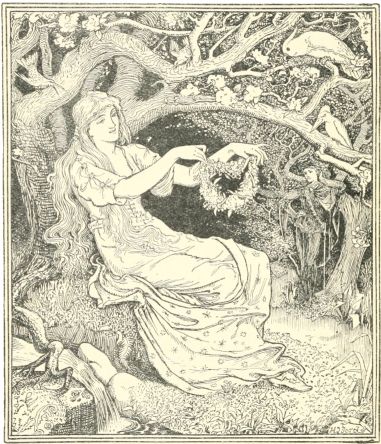
Once upon a time, there was a mighty baron in the North Countrie who was a great magician that knew everything that would come to pass. So one day, when his little boy was four years old, he looked into the Book of Fate to see what would happen to him. And to his dismay, he found that his son would wed a lowly maid that had just been born in a house under the shadow of York Minster. Now the Baron knew the father of the little girl was very, very poor, and he had five children already. So he called for his horse, and rode into York; and passed by the father's house, and saw him sitting by the door, sad and doleful. So he dismounted and went up to him and said: “What is the matter, my good man?” And the man said: “Well, your honour, the fact is, I've five children already, and now a sixth's come, a little lass, and where to get the bread from to fill their mouths, that's more than I can say.”
“Don't be downhearted, my man,” said the Baron. “If that's your trouble, I can help you. I'll take away the last little one, and you wont have to bother about her.”
“Thank you kindly, sir,” said the man; and he went in and brought out the lass and gave her to the Baron, who mounted his horse and rode away with her. And when he got by the bank of the river Ouse, he threw the little, thing into the river, and rode off to his castle.
But the little lass didn't sink; her clothes kept her up for a time, and she floated, and she floated, till she was cast ashore just in front of a fisherman's hut. There the fisherman found her, and took pity on the poor little thing and took her into his house, and she lived there till she was fifteen years old, and a fine handsome girl.
One day it happened that the Baron went out hunting with some companions along the banks of the River Ouse, and stopped at the fisherman's hut to get a drink, and the girl came out to give it to them. They all noticed her beauty, and one of them said to the Baron: “You can read fates, Baron, whom will she marry, d'ye think?”
“Oh! that's easy to guess,” said the Baron; “some yokel or other. But I'll cast her horoscope. Come here girl, and tell me on what day you were born?”
“I don't know, sir,” said the girl, “I was picked up just here after having been brought down by the river about fifteen years ago.”
Then the Baron knew who she was, and when they went away, he rode back and said to the girl: “Hark ye, girl, I will make your fortune. Take this letter to my brother in Scarborough, and you will be settled for life.” And the girl took the letter and said she would go. Now this was what he had written in the letter:
“Dear Brother,--Take the bearer and put her to death immediately.
“Yours affectionately,
“Albert.”
So soon after the girl set out for Scarborough, and slept for the night at a little inn. Now that very night a band of robbers broke into the inn, and searched the girl, who had no money, and only the letter. So they opened this and read it, and thought it a shame. The captain of the robbers took a pen and paper and wrote this letter:
“Dear Brother,--Take the bearer and marry her to my son immediately.
“Yours affectionately,
“Albert.”
And then he gave it to the girl, bidding her begone. So she went on to the Baron's brother at Scarborough, a noble knight, with whom the Baron's son was staying. When she gave the letter to his brother, he gave orders for the wedding to be prepared at once, and they were married that very day.
Soon after, the Baron himself came to his brother's castle, and what was his surprise to find that the very thing he had plotted against had come to pass. But he was not to be put off that way; and he took out the girl for a walk, as he said, along the cliffs. And when he got her all alone, he took her by the arms, and was going to throw her over. But she begged hard for her life. “I have not done anything,” she said: “if you will only spare me, I will do whatever you wish. I will never see you or your son again till you desire it.” Then the Baron took off his gold ring and threw it into the sea, saying: “Never let me see your face till you can show me that ring;” and he let her go.
The poor girl wandered on and on, till at last she came to a great noble's castle, and she asked to have some work given to her; and they made her the scullion girl of the castle, for she had been used to such work in the fisherman's hut.
Now one day, who should she see coming up to the noble's house but the Baron and his brother and his son, her husband. She didn't know what to do; but thought they would not see her in the castle kitchen. So she went back to her work with a sigh, and set to cleaning a huge big fish that was to be boiled for their dinner. And, as she was cleaning it, she saw something shine inside it, and what do you think she found? Why, there was the Baron's ring, the very one he had thrown over the cliff at Scarborough. She was right glad to see it, you may be sure. Then she cooked the fish as nicely as she could, and served it up.
Well, when the fish came on the table, the guests liked it so well that they asked the noble who cooked it. He said he didn't know, but called to his servants: “Ho, there, send up the cook that cooked that fine fish.” So they went down to the kitchen and told the girl she was wanted in the hall. Then she washed and tidied herself and put the Baron's gold ring on her thumb and went up into the hall.
When the banqueters saw such a young and beautiful cook they were surprised. But the Baron was in a tower of a temper, and started up as if he would do her some violence. So the girl went up to him with her hand before her with the ring on it; and she put it down before him on the table. Then at last the Baron saw that no one could fight against Fate, and he handed her to a seat and announced to all the company that this was his son's true wife; and he took her and his son home to his castle; and they all lived as happy as could be ever afterwards.
THE MAGPIE'S NEST
Once upon a time when pigs spoke rhyme And monkeys chewed tobacco, And hens took snuff to make them tough, And ducks went quack, quack, quack, O!
All the birds of the air came to the magpie and asked her to teach them how to build nests. For the magpie is the cleverest bird of all at building nests. So she put all the birds round her and began to show them how to do it. First of all she took some mud and made a sort of round cake with it.
“Oh, that's how it's done,” said the thrush; and away it flew, and so that's how thrushes build their nests.
Then the magpie took some twigs and arranged them round in the mud.
“Now I know all about it,” says the blackbird, and off he flew; and that's how the blackbirds make their nests to this very day.
Then the magpie put another layer of mud over the twigs.
“Oh that's quite obvious,” said the wise owl, and away it flew; and owls have never made better nests since.
After this the magpie took some twigs and twined them round the outside.
“The very thing!” said the sparrow, and off he went; so sparrows make rather slovenly nests to this day.
Well, then Madge Magpie took some feathers and stuff and lined the nest very comfortably with it.
“That suits me,” cried the starling, and off it flew; and very comfortable nests have starlings.
So it went on, every bird taking away some knowledge of how to build nests, but, none of them waiting to the end. Meanwhile Madge Magpie went on working and working without, looking up till the only bird that remained was the turtle-dove, and that hadn't paid any attention all along, but only kept on saying its silly cry “Take two, Taffy, take two-o-o-o.”
At last the magpie heard this just as she was putting a twig across. So she said: “One's enough.”
But the turtle-dove kept on saying: “Take two, Taffy, take two-o-o-o.”
Then the magpie got angry and said: “One's enough I tell you.”
Still the turtle-dove cried: “Take two, Taffy, take two-o-o-o.”
At last, and at last, the magpie looked up and saw nobody near her but the silly turtle-dove, and then she got rare angry and flew away and refused to tell the birds how to build nests again. And that is why different birds build their nests differently.
KATE CRACKERNUTS
Once upon a time there was a king and a queen, as in many lands have been. The king had a daughter, Anne, and the queen had one named Kate, but Anne was far bonnier than the queen's daughter, though they loved one another like real sisters. The queen was jealous of the king's daughter being bonnier than her own, and cast about to spoil her beauty. So she took counsel of the henwife, who told her to send the lassie to her next morning fasting.
So next morning early, the queen said to Anne, “Go, my dear, to the henwife in the glen, and ask her for some eggs.” So Anne set out, but as she passed through the kitchen she saw a crust, and she took and munched it as she went along.
When she came to the henwife's she asked for eggs, as she had been told to do; the henwife said to her, “Lift the lid off that pot there and see.” The lassie did so, but nothing happened. “Go home to your minnie and tell her to keep her larder door better locked,” said the henwife. So she went home to the queen and told her what the henwife had said. The queen knew from this that the lassie had had something to eat, so watched the next morning and sent her away fasting; but the princess saw some country-folk picking peas by the roadside, and being very kind she spoke to them and took a handful of the peas, which she ate by the way.
When she came to the henwife's, she said, “Lift the lid off the pot and you'll see.” So Anne lifted the lid but nothing happened. Then the henwife was rare angry and said to Anne, “Tell your minnie the pot won't boil if the fire's away.” So Anne went home and told the queen.
The third day the queen goes along with the girl herself to the henwife. Now, this time, when Anne lifted the lid off the pot, off falls her own pretty head, and on jumps a sheep's head.
So the queen was now quite satisfied, and went back home.
Her own daughter, Kate, however, took a fine linen cloth and wrapped it round her sister's head and took her by the hand and they both went out to seek their fortune. They went on, and they went on, and they went on, till they came to a castle. Kate knocked at the door and asked for a night's lodging for herself and a sick sister. They went in and found it was a king's castle, who had two sons, and one of them was sickening away to death and no one could find out what ailed him. And the curious thing was that whoever watched him at night was never seen any more. So the king had offered a peck of silver to anyone who would stop up with him. Now Katie was a very brave girl, so she offered to sit up with him.
Till midnight all goes well. As twelve o clock rings, however, the sick prince rises, dresses himself, and slips downstairs. Kate followed, but he didn't seem to notice her. The prince went to the stable, saddled his horse, called his hound, jumped into the saddle, and Kate leapt lightly up behind him. Away rode the prince and Kate through the greenwood, Kate, as they pass, plucking nuts from the trees and filling her apron with them. They rode on and on till they came to a green hill. The prince here drew bridle and spoke, “Open, open, green hill, and let the young prince in with his horse and his hound,” and Kate added, “and his lady him behind.”
Immediately the green hill opened and they passed in. The prince entered a magnificent hall, brightly lighted up, and many beautiful fairies surrounded the prince and led him off to the dance. Meanwhile, Kate, without being noticed, hid herself behind the door. There she sees the prince dancing, and dancing, and dancing, till he could dance no longer and fell upon a couch. Then the fairies would fan him till he could rise again and go on dancing.
At last the cock crew, and the prince made all haste to get on horseback; Kate jumped up behind, and home they rode. When the morning sun rose they came in and found Kate sitting down by the fire and cracking her nuts. Kate said the prince had a good night; but she would not sit up another night unless she was to get a peck of gold. The second night passed as the first had done. The prince got up at midnight and rode away to the green hill and the fairy ball, and Kate went with him, gathering nuts as they rode through the forest. This time she did not watch the prince, for she knew he would dance and dance, and dance. But she sees a fairy baby playing with a wand, and overhears one of the fairies say: “Three strokes of that wand would make Kate's sick sister as bonnie as ever she was.” So Kate rolled nuts to the fairy baby, and rolled nuts till the baby toddled after the nuts and let fall the wand, and Kate took it up and put it in her apron. And at cockcrow they rode home as before, and the moment Kate got home to her room she rushed and touched Anne three times with the wand, and the nasty sheep's head fell off and she was her own pretty self again. The third night Kate consented to watch, only if she should marry the sick prince. All went on as on the first two nights. This time the fairy baby was playing with a birdie; Kate heard one of the fairies say: “Three bites of that birdie would make the sick prince as well as ever he was.” Kate rolled all the nuts she had to the fairy baby till the birdie was dropped, and Kate put it in her apron.
At cockcrow they set off again, but instead of cracking her nuts as she used to do, this time Kate plucked the feathers off and cooked the birdie. Soon there arose a very savoury smell. “Oh!” said the sick prince, “I wish I had a bite of that birdie,” so Kate gave him a bite of the birdie, and he rose up on his elbow. By-and-by he cried out again: “Oh, if I had another bite of that birdie!” so Kate gave him another bite, and he sat up on his bed. Then he said again: “Oh! if I only had a third bite of that birdie!” So Kate gave him a third bite, and he rose quite well, dressed himself, and sat down by the fire, and when the folk came in next morning they found Kate and the young prince cracking nuts together. Meanwhile his brother had seen Annie and had fallen in love with her, as everybody did who saw her sweet pretty face. So the sick son married the well sister, and the well son married the sick sister, and they all lived happy and died happy, and never drank out of a dry cappy.
THE CAULD LAD OF HILTON
At Hilton Hall, long years ago, there lived a Brownie that was the contrariest Brownie you ever knew. At night, after the servants had gone to bed, it would turn everything topsy-turvy, put sugar in the salt-cellars, pepper into the beer, and was up to all kinds of pranks. It would throw the chairs down, put tables on their backs, rake out fires, and do as much mischief as could be. But sometimes it would be in a good temper, and then!--“What's a Brownie?” you say. Oh, it's a kind of a sort of a Bogle, but it isn't so cruel as a Redcap! What! you don't know what's a Bogle or a Redcap! Ah, me! what's the world a-coming to? Of course a Brownie is a funny little thing, half man, half goblin, with pointed ears and hairy hide. When you bury a treasure, you scatter over it blood drops of a newly slain kid or lamb, or, better still, bury the animal with the treasure, and a Brownie will watch over it for you, and frighten everybody else away.
Where was I? Well, as I was a-saying, the Brownie at Hilton Hall would play at mischief, but if the servants laid out for it a bowl of cream, or a knuckle cake spread with honey, it would clear away things for them, and make everything tidy in the kitchen. One night, however, when the servants had stopped up late, they heard a noise in the kitchen, and, peeping in, saw the Brownie swinging to and fro on the Jack chain, and saying:
“Woe's me! woe's me! The acorn's not yet Fallen from the tree, That's to grow the wood, That's to make the cradle, That's to rock the bairn, That's to grow to the man, That's to lay me. Woe's me! woe's me!”
So they took pity on the poor Brownie, and asked the nearest henwife what they should do to send it away. “That's easy enough,” said the henwife, and told them that a Brownie that's paid for its service, in aught that's not perishable, goes away at once. So they made a cloak of Lincoln green, with a hood to it, and put it by the hearth and watched. They saw the Brownie come up, and seeing the hood and cloak, put them on, and frisk about, dancing on one leg and saying:
“I've taken your cloak, I've taken your hood; The Cauld Lad of Hilton will do no more good.”
And with that it vanished, and was never seen or heard of afterwards.